

Last Updated: November 5, 2026
Quick Summary
To book NDIS taxi Perth services, confirm your transport budget and funding level in your plan, then give the operator your pickup details, mobility equipment and transfer needs. Request the right vehicle type, confirm the fare basis and payment method in writing, and record a booking reference and arrival window.
- NDIS transport funding levels range from $1,784 to $3,456 annually depending on assessed need.
- Confirm the specific vehicle has a ramp or hoist, since a maxi taxi is not automatically accessible.
- The taxi subsidy is applied to the fare first, then the remainder is paid or claimed.
- Ask your plan manager how they want subsidy-adjusted fares recorded before your first subsidised trip.
- Book wheelchair-accessible vehicles early because they are a smaller part of many fleets.
Table of Contents
- Getting Started with NDIS Taxi Booking
- How to Book an NDIS Taxi Step by Step
- Step 1: Confirm your transport budget and funding level
- Step 2: Decide who books
- Step 3: Prepare the trip information before you call
- Step 4: Request the right vehicle type
- Step 5: Confirm the fare basis and payment method
- Step 6: Get a booking reference and arrival window
- Step 7: Keep the receipt or invoice for your plan records
- Booking by Phone or Online
- Wheelchair Accessible Taxi Booking: What to Confirm
- How NDIS Transport Funding and Taxi Subsidies Work Together
- Your Taxi Booking Checklist Before the Trip
- Lead Times, Cancellations and Changes
- Trip-Day Support and Common Trip Types
- Book Your Accessible Ride with Universal Cabs
- Frequently Asked Questions
Getting Started with NDIS Taxi Booking
Booking an NDIS taxi Perth participants can rely on starts with one question: does your plan fund transport, and at what level? Matching your funding to the right vehicle and booking method is what matters most.
Below, we walk through eligibility, the booking steps, what to confirm about wheelchair access, and how NDIS funding interacts with taxi subsidies.
Who Can Use NDIS Transport Funding
NDIS transport funding is a plan budget that helps participants travel to appointments, work, study and community activities when standard transport is not accessible or affordable. The NDIS sets three funding levels, with annual amounts ranging from $1,784 to $3,456 depending on assessed need, according to Centre of Hope’s guide to NDIS transport funding.
Your level appears in your plan. If you are unsure how your plan is managed, our guide to NDIS plan management for wheelchair taxi users explains the options.
How to Book an NDIS Taxi Step by Step
Booking an NDIS taxi follows a short sequence, and getting the order right prevents most trip-day problems. The steps below are written for participants, carers and support coordinators, and each one produces something you can hand to the operator or keep for your plan records.
Step 1: Confirm your transport budget and funding level
Open your NDIS plan and find the transport category. Note the funding level and the annual amount allocated. If your plan is plan-managed or self-managed, note who can authorise payment; if it is NDIA-managed, confirm the operator can invoice the NDIS directly. Write down the budget line name exactly as it appears in the plan, plan managers reconcile invoices against that wording.
Step 2: Decide who books
You can book yourself, ask a carer or family member, or have your support coordinator book on your behalf. If someone else books, give them written authority to act on your transport budget and tell the operator at the time of booking who the authorised contact is. A common pattern is for the participant to book recurring trips and the coordinator to book one-off medical journeys.
Step 3: Prepare the trip information before you call
Have these details ready so the booking is not delayed:
- Pickup address, including unit number, gate code, intercom instructions and where the vehicle can legally stop
- Destination address and the entrance the driver should use (for example, a hospital transport bay rather than the main entrance)
- Appointment time and the time you need to be at the destination, not just the appointment start
Step 4: Request the right vehicle type
Tell the operator explicitly whether you need a wheelchair-accessible vehicle, a maxi taxi for a group, or a standard sedan. Do not assume a maxi taxi is accessible, confirm the specific vehicle has a ramp or hoist and an approved restraint system. If you use a larger or heavier chair, say so at booking; not every accessible vehicle can carry every chair.
Step 5: Confirm the fare basis and payment method
Ask how the fare is calculated and whether tolls, waiting time and after-hours charges are included. Confirm how payment will be handled: card in the vehicle, invoice to your plan manager, or a combination with a taxi subsidy applied. Ask for the fare basis in writing (SMS or email) so there is no dispute later.
Step 6: Get a booking reference and arrival window
Ask for a booking reference number and the driver’s arrival window, not a single time. Record both. If the operator offers SMS or app tracking, opt in so you can see when the vehicle is close.
Step 7: Keep the receipt or invoice for your plan records
Ask for a tax invoice that shows the trip date, pickup and destination, fare, any subsidy applied, and the amount charged to you or your plan. File it against the correct budget line.
Watch out: booking a return trip as two separate bookings can leave you without a vehicle if the operator’s afternoon availability is tight, ask for the return to be linked to the same booking reference where possible.
Booking by Phone or Online
Phone booking an NDIS taxi Perth participants can rely on suits those who need to explain mobility equipment or support requirements. Online booking suits repeat trips and simple point-to-point journeys. Either way, give the operator your NDIS status up front so the right vehicle is allocated.
Here is the booking sequence at a glance, with what each step produces for your records.
| Step | What to do | What you get |
|---|---|---|
| 1 | Confirm transport budget and funding level | Budget line name from your plan |
| 2 | Decide who books | Authorised contact named to operator |
| 3 | Prepare trip information before calling | Pickup, destination, equipment, transfer needs |
| 4 | Request the right vehicle type | Confirmed accessible vehicle, ramp or hoist |
| 5 | Confirm fare basis and payment method | Fare basis in writing by SMS or email |
| 6 | Get a booking reference and arrival window | Reference number and arrival window recorded |
| 7 | Keep the receipt or invoice | Tax invoice filed against budget line |
Wheelchair Accessible Taxi Booking: What to Confirm
Wheelchair accessible taxi booking comes down to four confirmations: the vehicle carries the right restraint system, the driver is trained to secure it, the ramp or hoist suits your chair, and the operator has the vehicle available at your time. Ask for these details when you book, not when the taxi arrives.
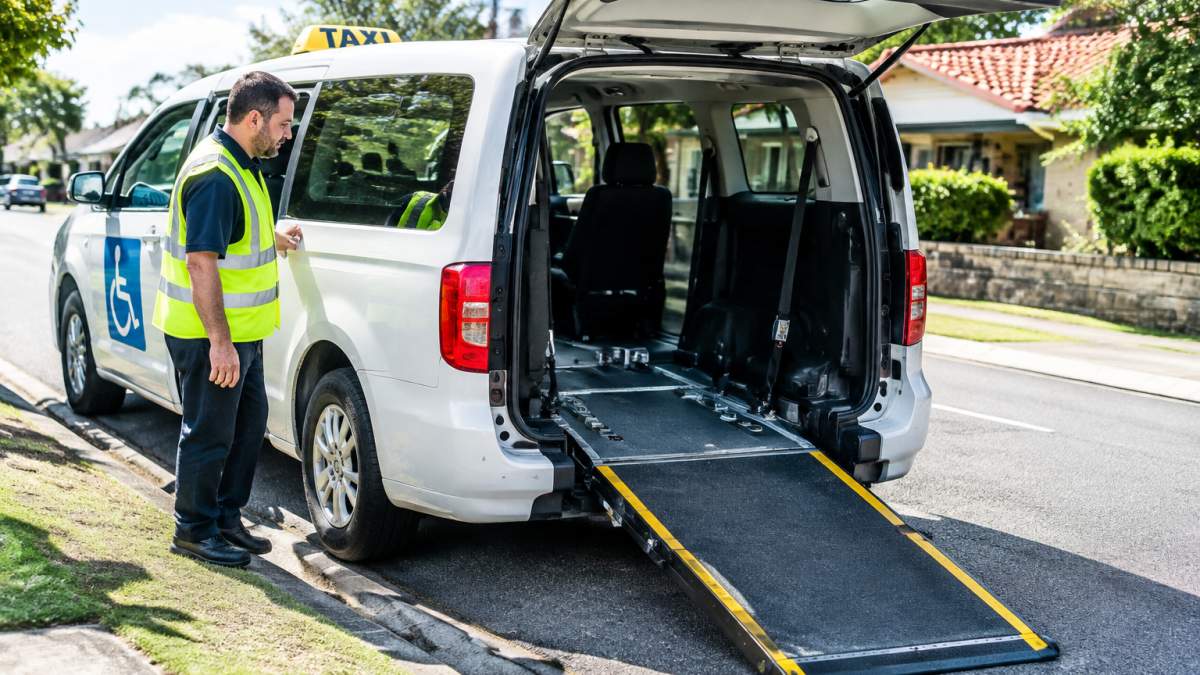
Watch out: a standard maxi taxi is not automatically wheelchair accessible. Confirm the specific vehicle, not just the category.
How NDIS Transport Funding and Taxi Subsidies Work Together
NDIS funding and the Taxi Users’ Subsidy Scheme are separate supports, and they can work in combination, but they are not interchangeable, and confusing them is one of the most common reasons a transport invoice is rejected. Understanding which support pays for what, and in what order, saves participants both money and administrative time.
What each support actually covers
NDIS transport funding is a plan budget that helps you travel to appointments, work, study and community activities when standard transport is not accessible or affordable. It is tied to your plan goals and is released according to your plan management type. The Taxi Users’ Subsidy Scheme, by contrast, is a state-based concession that reduces the fare you pay on eligible taxi trips.
The order of application
In practice, the subsidy is applied to the fare first, reducing the amount payable. The remaining amount is then either paid by you or claimed against your NDIS transport budget, depending on your plan arrangements. The exact sequence matters because plan managers reconcile against the net amount, not the gross fare. If the subsidy is applied after the invoice is issued, the invoice may need to be reissued before it can be claimed.
How to verify your eligibility
Eligibility for the subsidy is determined by the administering state agency, not by the taxi operator and not by the NDIS. Before your first trip, check the current eligibility criteria, the application process and any renewal requirements directly with that agency. Keep a copy of your approval or registration number, because operators will ask for it when applying the subsidy.
What to tell your plan manager
Before your first subsidised trip, ask your plan manager three questions: how they want subsidy-adjusted fares recorded on invoices, whether they need the subsidy reference number on each invoice, and whether they will accept a single invoice that shows both the gross fare and the subsidy deduction. Getting answers in writing prevents the back-and-forth that delays reimbursement.
Watch out: do not assume a trip that is eligible for the taxi subsidy is automatically claimable against your NDIS transport budget, the trip must also relate to your plan goals, and the two tests are separate.
Our step-by-step guide to applying for PTSS taxi subsidies covers the paperwork.
Your Taxi Booking Checklist Before the Trip
Run through this taxi booking checklist the day before travel. It catches the gaps that cause missed appointments.
- Pickup address includes gate codes, unit numbers and parking notes
- Appointment time confirmed, with a realistic travel buffer
- Vehicle type and accessibility needs reconfirmed
- Fare basis and payment method agreed
Lead Times, Cancellations and Changes
Lead times vary by operator and vehicle type, so ask when you book rather than assuming. Wheelchair-accessible vehicles are a smaller part of many fleets, so it is worth booking them early.
Cancellation windows and fees are set by each operator, so confirm the terms before you commit. Our guide to cancelling a wheelchair taxi sets out what to have ready.
Trip-Day Support and Common Trip Types
Trip-day support covers more than the drive. Tell the operator if you need door-to-door assistance, help with a walking frame, or extra time to board. Drivers who know in advance can plan the pickup properly.
Common NDIS trips include medical appointments and hospital visits, rehabilitation travel, work and study commutes, community activities, aged care visits and airport transfers.
Book Your Accessible Ride with Universal Cabs
The challenge is not finding a taxi. It is finding one that arrives when booked, carries the right equipment, and bills in a way your plan can process.
Ready to arrange your next trip? Book NDIS transport with our team, or use our wheelchair taxi booking page to reserve an accessible vehicle directly.
Frequently Asked Questions
How do I book a taxi for an NDIS participant?
Start by confirming your NDIS plan includes transport funding, then call or book online with a provider that runs wheelchair-accessible vehicles. Give the booking agent the participant’s name, pickup address, destination, appointment time and any mobility equipment being carried. Ask whether the driver can assist with doors and securements, and request a fare estimate before the trip so you can budget from your plan. Universal Cabs takes bookings by phone or online around the clock, and its fleet includes wheelchair-accessible options.
Can NDIS funding cover taxi or transport costs?
NDIS transport funding can cover taxi travel where the trip relates to your plan goals, such as getting to appointments, work, study or community activities. Funding is tiered according to your assessed need, and your plan shows your level. Trips must be reasonable and necessary, and you should keep records of each journey. Check your plan or speak with your support coordinator about what your specific budget allows before booking.
How far ahead should I book a wheelchair accessible taxi?
Book as early as you can for wheelchair accessible taxi booking, especially for medical appointments and peak travel times. Booking a day or more ahead gives you a better chance of securing the right vehicle. For airport transfers or hospital visits with a fixed time, confirm the booking the day before and note your flight or appointment details so the driver can plan. Universal Cabs runs 24/7, so you can call to check availability.
What should I do if my taxi is late or my plans change?
Call the operator as soon as you know plans have changed so the booking can be adjusted or cancelled without a wasted trip. If the taxi is late, contact the provider with your booking reference and ask for an updated arrival time. Keep your appointment provider informed if a delay looks likely. Use a taxi booking checklist to record the booking reference, driver details and fare estimate, which makes any follow-up call faster and gives you a clear record for your NDIS transport funding claims.
A reliable NDIS taxi booking is built on confirmed details, not hope. Start with your funding level, confirm the vehicle and fare basis, then book with lead time to spare.
