

Last Updated: October 23, 2026
Quick Summary
Choosing the right NDIS transport support worker in Perth means verifying the provider’s NDIS registration, insurance and accessible vehicles, then checking the worker’s training and fit through scenario questions and a paid trial trip. Confirm worker time, travel charges and cancellation terms in writing before the first regular booking.
- Worker-assisted transport means a support worker travels with you; transport funding is money in your plan for travel itself.
- Ask for the transport line in your plan in writing before interviewing workers.
- Book one short paid trial trip before committing to a regular schedule.
- Wheelchair accessible transport needs certified restraints, a trained driver and regular availability, not just a ramp.
- Review the arrangement after four weeks and switch early if two or more answers are no.
Table of Contents
- What NDIS Transport Support Actually Covers
- Your NDIS Transport Provider Checklist
- Questions to Ask an NDIS Support Worker Before You Commit
- Wheelchair Accessible Transport for NDIS Participants
- NDIS Transport Plan Examples You Can Adapt
- Safety, Reassurance and Journey Planning
- Independent Workers or a Registered Provider?
- Trial, Review and Adjust
- Frequently Asked Questions
What NDIS Transport Support Actually Covers
Choosing the right NDIS transport support worker in Perth starts with knowing what the role actually involves. NDIS transport support is assistance that helps a participant get to and from the places they need to be, delivered by a trained worker in a suitable vehicle. It is not just a lift. It is a booked, planned service with a worker who knows the participant’s needs.
Worker-assisted transport versus transport funding
These are two different things, and mixing them up is the most common mistake we see.
- Worker-assisted transport means a support worker travels with the participant and provides help during the journey.
- Transport funding means money in a participant’s plan to pay for travel itself.
Some plans fund one, some fund the other, and some fund both. The rules depend on the participant’s goals and plan. Check the current guidance from the NDIS pricing arrangements and price limits before you build a budget around any figure.
Where transport sits in your support categories
Transport usually sits under core supports, because it helps with daily activities. But it can also connect to capacity building when the goal is learning to travel independently. Your plan manager or support coordinator can confirm which category applies.
Ask for the transport line in the plan in writing before you interview workers. Knowing the category and the budget stops awkward conversations later.
Your NDIS Transport Provider Checklist
A good NDIS transport provider checklist keeps the decision objective. You can also book reliable NDIS Transport Perth with Universal Cabs and check the service against this checklist. Use it to compare options side by side instead of going on first impressions. The list below goes further than most provider pages: it separates what to verify about the provider, what to verify about the worker, and what to confirm in writing before the first trip.
Provider-level checks
- Current NDIS registration status confirmed (ask for the registration number and check it against the NDIS Commission’s register)
- Public liability and professional indemnity insurance current
- Accessible vehicles available, including wheelchair-accessible options with certified restraints
- Drivers trained in disability support, manual handling and wheelchair securement
- Service coverage confirmed for the participant’s suburb and usual destinations
- Backup plan documented if the assigned worker is unavailable
- Complaints and incident procedures provided in writing
- References from other participants or support coordinators
Worker-level checks
- Worker has read the participant’s transport plan and support plan
- Worker knows the participant’s communication style and any aids or routines
- Worker can describe how they handle anxiety, delays and refusals during a trip
- Worker has completed NDIS Worker Orientation Module and any relevant safety training
- Worker understands manual handling and securement for the participant’s specific equipment
Written-agreement checks
- Service agreement sets out worker time, travel time and any vehicle or distance charges
- Cancellation terms and notice periods are clear
- Schedule-change process is documented
- Funding category and budget line are confirmed with the plan manager or support coordinator
- Review date and trial period are agreed
A provider that hesitates on any written-agreement item is telling you something useful before you commit.
Questions to Ask an NDIS Support Worker Before You Commit
Interviews are where good matches are made or missed. Ask questions that reveal how a worker handles real situations, not just their qualifications on paper.
Try these:
- Walk me through a time a participant was anxious during a trip. What did you do?
- How do you handle a delay that makes an appointment run late?
- What would you do if a participant refused to get out of the vehicle?
- How do you keep family updated during a longer journey?
- What training have you done on manual handling and wheelchair securement?
Scenario-based questions beat yes-or-no questions every time. They show judgement, communication and reliability in one answer.
Skipping the trial shift is the mistake that hurts most. A worker who interviews well can still be the wrong fit in the car. Book one short paid trip before committing to a regular schedule.
Wheelchair Accessible Transport for NDIS Participants
Wheelchair accessible transport for NDIS participants needs more than a ramp. It needs correct tie-down points, a trained driver and enough space for the chair to be secured safely.
Ask three things before booking:
- Does the vehicle have certified restraints for the chair?
- Is the driver trained in securement and loading?
- Can the provider confirm availability for regular bookings?
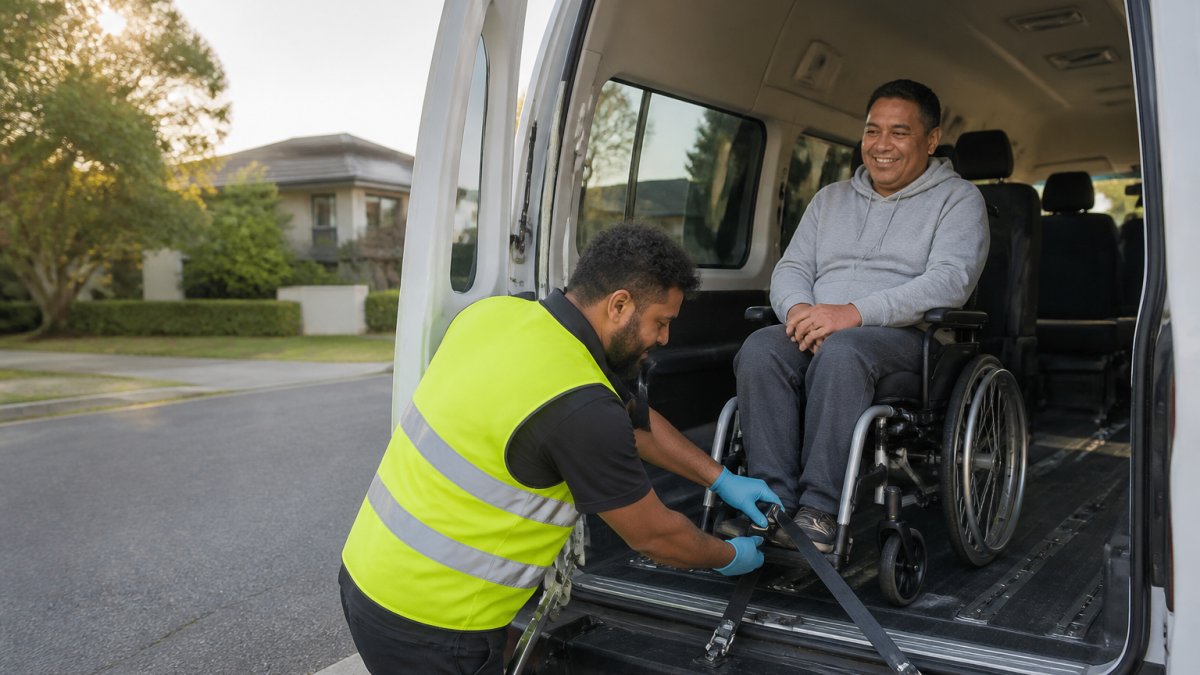
Availability is the sticking point. Many participants tell us they can find an accessible vehicle once, but not every week. For the deeper detail on plan management and chair-specific travel, a guide on wheelchair taxi services and plan management can cover the funding side.
NDIS Transport Plan Examples You Can Adapt
A transport plan is a short written summary of how a participant will travel, with whom, and how it is funded. It saves time on every booking.
Here are two examples you can adapt.
Example one: weekly appointments
- Goal: attend physiotherapy every Tuesday
- Worker: same driver each week for consistency
- Vehicle: sedan, with space for a walking frame
- Funding: core supports, transport line
- Backup: provider confirms a substitute driver in advance
Example two: community participation
- Goal: attend a social group twice a month
- Worker: support worker who stays for the session
- Vehicle: accessible van with securement
- Funding: capacity building, travel training goal
- Review: check progress after eight weeks
Keep the plan to one page. Anything longer gets ignored.
Safety, Reassurance and Journey Planning
Safety and reassurance come from planning, not luck. A participant should know who is coming, when, and what happens if plans change. Most provider pages stop at that sentence. The detail below is what a support coordinator will actually ask you about.
Vehicle and transfer suitability
Before the first regular booking, confirm:
- The vehicle has certified tie-down points and restraints for the participant’s chair or mobility aid
- The driver is trained in securement and safe loading and unloading
- There is enough space for the participant to transfer safely, with a stable surface and grab points
- The vehicle is suitable for the participant’s size, equipment and any behavioural needs
- The provider can confirm availability for regular bookings, not just one-off trips
Communication and reassurance
Agree in advance:
- Who contacts the participant the day before to confirm pickup time and location
- How the driver’s name and vehicle details are shared
- Who the participant or family can call during the journey
- How updates are given during longer trips or delays
- What the participant should do if the driver does not arrive
Emergency planning
A written emergency plan should cover:
- Medical events during a journey, including who calls emergency services and who contacts the family
- Traffic or road closures that make an appointment run late
- A participant who becomes distressed or refuses to leave the vehicle
- Vehicle breakdown and the substitute transport arrangement
- Incident reporting to the provider and, where required, to the NDIS Commission
What to confirm in writing
Ask for the service agreement to set out worker time, travel time, any vehicle or distance charges, cancellation notice periods and the schedule-change process. These terms are where surprises usually appear, and a provider that cannot put them in writing is a risk worth avoiding.
Ask any provider how they screen drivers, what training they require and what happens after an incident. You can also review the provider’s safety and insurance standards before booking. A vague answer is your answer.
Independent Workers or a Registered Provider?
Both routes work, and the choice depends on the participant’s needs. Independent support workers can offer flexibility and a closer personal match. Registered providers offer structure, insurance and backup cover.
| Factor | Independent worker | Registered provider |
|---|---|---|
| Flexibility | High, negotiates directly | Set schedules and processes |
| Backup cover | Limited if the worker is sick | Usually arranged |
| Insurance and screening | Verify yourself | Checked by the provider |
| Accessibility | Depends on their own vehicle | Fleet often includes accessible options |
| Paperwork | You manage agreements | Provider supplies agreements |
If accessibility is the deciding factor, compare services before you commit. For the funding side, read how to apply for PTSS taxi support so you know what the scheme covers.
Choose a registered provider when reliability and accessible vehicles matter most. Choose an independent worker when continuity with one person matters more than backup cover.
Trial, Review and Adjust
The first month is a test, not a commitment. Book a trial period, then review it honestly against the checklist you started with.
Review these points after four weeks:
- Did the worker arrive on time every trip?
- Did the participant feel comfortable and safe?
- Were cancellations handled fairly?
- Did the funding cover the actual travel?
If two or more answers are no, change the arrangement. Participant choice is central to the scheme, and switching early costs less than enduring a poor match. Current scheme changes are worth tracking through the Department of Health, Disability and Ageing guidance on NDIS changes, since funding settings can shift between plan reviews.
Frequently Asked Questions
What should I look for in an NDIS transport support worker?
Start with the practical basics: a current driver licence, a Working with Children Check where relevant, first aid training and a police check. Then look at how they handle your specific needs, such as wheelchair loading, route planning around appointments and communication style. Ask for references from participants with similar support needs. A good NDIS transport support worker knows your regular destinations, arrives early, and tells you in advance if anything changes. Trial a few short journeys before committing to a regular arrangement.
Can NDIS funding cover transport to appointments and community activities?
NDIS funding can cover transport in some circumstances, but the rules depend on your plan, your goals and how the support is classified. Worker-assisted transport, where a support worker travels with you, is generally treated differently from a transport allowance or a provider’s travel costs. Check your plan’s support categories and confirm with your support coordinator or the NDIS directly before assuming a trip is funded. Keep records of each journey so claims are easy to support.
What is the difference between transport assistance and a support worker travelling with me?
Transport assistance usually means funding or arranging the ride itself, such as a taxi or accessible vehicle fare. A support worker travelling with you adds a person who can help with doors, luggage, navigation, settling at the destination and safety along the way. The second option suits participants who need hands-on help or reassurance during the journey. Your plan may fund one, the other, or a mix, so clarify the distinction with your planner before booking.
How do I check whether a transport provider can meet my accessibility needs?
Ask directly what vehicles they run and whether they carry ramps or hoists, then request a short trial journey with your own mobility equipment. Confirm how many accessible vehicles are available at the times you usually travel, and what happens if one is off the road. Check that the driver has loaded your chair type before. A provider that answers these questions with specifics, rather than general reassurance, is the safer choice for regular accessible transport.
Matching a participant with the right transport worker takes a checklist, a trial and an honest review. Universal Cabs supports that process with 24/7 availability, a fleet that includes wheelchair accessible vehicles and Maxi Taxis, and experienced drivers who know local routes. Our rates stay the same day, night and for airport trips, with no hidden spikes. Get started with Universal Cabs and give every journey a reliable, professional driver.
