

Table of Contents
- How NDIS Plan Management Affects Your Wheelchair Taxi Bookings
- NDIS Transport Funding Rules for Accessible Taxis
- NDIS Core Support Transport Budget: How It Works
- How to Claim Taxi Fares NDIS: A Step-by-Step Process
- Booking a Wheelchair-Accessible Taxi: What to Expect
- Resolving Problems with NDIS Transport Services
- Frequently Asked Questions
Last Updated: September 25, 2026
How NDIS Plan Management Affects Your Wheelchair Taxi Bookings
The way your NDIS plan is managed decides how you pay for a wheelchair taxi Perth trip. It also shapes how much paperwork lands on your desk.
Self-Managed, Plan-Managed, and NDIA-Managed: What Changes
Self-managed means you pay the provider first, then claim the money back from your plan. You keep the receipts and lodge the claim yourself.
The practical difference comes down to three things:
- Who pays the driver on the day
- Who keeps the receipts
- How fast the provider gets paid
Plan-managed and NDIA-managed participants can book and ride without paying upfront. Self-managed participants pay first and claim back later, so keep every receipt.
NDIS Transport Funding Rules for Accessible Taxis
Transport funding sits inside your Core Supports budget. It covers travel to work, medical appointments, community access, and social activities.
The NDIS splits transport into two broad areas:
- General transport for everyday travel
- Transport assistance for people who cannot use public transport because of mobility limitations
Which Support Category Covers Wheelchair Taxi Fares
Wheelchair taxi fares sit under Core Supports, Assistance with Social and Community Participation. This is the line item that pays for getting out and about.
Three rules matter here:
- The trip must link to a goal in your plan
- The fare must be reasonable for the distance
- You cannot claim trips a mainstream service already covers
NDIS Core Support Transport Budget: How It Works
Your NDIS core support transport budget is the pool of money set aside for travel. It is not unlimited, and it does not roll over forever.
Two funding models exist:
- Flexible funding you can shift between Core Support categories
- Stated funding locked to a specific purpose
If you overspend your transport budget early, you may have no funds left for appointments later in the plan. Check your balance before booking regular trips.
How to Claim Taxi Fares NDIS: A Step-by-Step Process
Claiming is straightforward once you know your plan type, but the mechanism differs enough that using the wrong path can delay reimbursement by weeks. The steps below separate the three pathways so you can follow the one that matches your plan.
Self-managed: pay first, claim back
- Confirm your transport budget balance before you travel, so you know the fare will be covered.
- Book your wheelchair-accessible taxi and keep the booking reference.
- Pay the driver on the day and ask for a tax invoice, not just a receipt.
- Check the invoice shows the provider’s ABN, date, pickup and drop-off, distance, fare, and any waiting time.
- Log in to the NDIS participant portal (or your nominated claiming method) and submit the invoice against Core Supports – Assistance with Social and Community Participation.
- Keep the invoice and your bank record for at least five years.
Most self-managed participants find claims are processed within a few business days when the invoice is complete. If a detail is missing, the claim is usually returned rather than rejected, so you can correct and resubmit.
Plan-managed: your plan manager pays
- Give your plan manager the provider’s details before your first trip, so they can set the provider up in their system.
- Book the taxi and travel without paying upfront, provided the provider invoices your plan manager directly.
- Ask the driver to send the tax invoice to your plan manager, or forward it yourself the same day.
- Your plan manager checks the invoice against your transport budget and pays the provider.
- Review your monthly plan manager statement to confirm the trip has been recorded against the right category.
A common pattern is for plan managers to require the invoice within seven days of travel. Late invoices are still payable, but they can push the trip into the next reporting period, which complicates budget tracking.
NDIA-managed: the provider claims directly
- Confirm the provider is NDIS-registered before you book. NDIA-managed participants cannot use unregistered providers for this support.
- Book the taxi and travel without paying upfront.
- The provider claims the fare directly from the NDIA against your plan.
- Check your participant portal to confirm the trip appears against your transport budget.
If a provider is not registered, you cannot use this pathway. You would need to switch to self-managed or plan-managed, or choose a registered operator.
Invoice requirements and record keeping
A valid tax invoice needs specific details. Missing any of them can delay your claim.
| Invoice Item | What It Must Show |
|---|---|
| Provider details | Business name and ABN |
| Trip details | Date, pickup, and drop-off |
| Fare | Total charged, including any waiting time |
| Service type | Wheelchair-accessible transport |
| Reference | Booking or job number |
Photograph the invoice before you leave the vehicle. If the paper copy is lost, the photo is enough to lodge the claim.
What to do if a claim is rejected
Rejections usually come down to one of four things: the invoice is missing the ABN, the trip is not linked to a goal in your plan, the fare is above what the NDIS considers reasonable for the distance, or the service was already covered by another funding source. Ask your plan manager or support coordinator which reason applies, correct the invoice or the record, and resubmit.
Booking a Wheelchair-Accessible Taxi: What to Expect
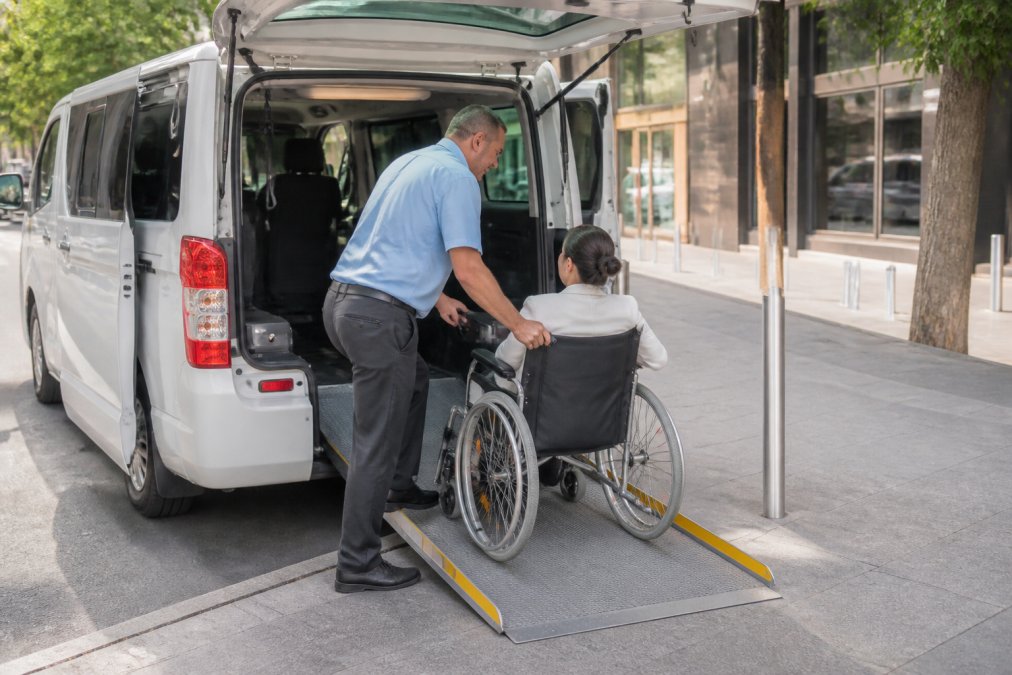
Booking a wheelchair-accessible vehicle works much like a standard taxi, with a few extra details that determine whether the right vehicle turns up. Tell the operator your wheelchair type, its size and weight, and whether you travel with a carer.
Phone booking versus app booking
Not every accessible taxi can be booked through an app. In practice, the booking method depends on the operator:
- Phone dispatch remains the most reliable route for wheelchair-accessible vehicles, because the dispatcher can confirm the vehicle type, ramp or hoist, and tie-down points before assigning a driver.
- App booking works for some operators, but the app may not let you specify wheelchair dimensions or equipment needs. If you book through an app, call the operator afterwards to confirm the vehicle is suitable.
- Pre-booked regular trips are the most reliable option for recurring appointments. Give as much notice as you can, ideally 24 hours or more, so the operator can allocate a suitable vehicle.
What to have ready when you book
When you book, have these details ready:
- Pickup address and any access notes, such as a rear laneway or a gate code
- Your wheelchair dimensions and weight, including the occupied weight
- Whether you need a hoist or a ramp
- Whether you can transfer to a seat or need to travel in your wheelchair
- The number of passengers travelling, including a carer
- Your return trip time, if needed
Giving accurate dimensions matters. A vehicle that fits a manual wheelchair may not fit a larger power chair, and the operator needs to know before dispatch.
Hoists versus ramps: vehicle safety requirements
Accessible vehicles use either a ramp or a hoist. The right choice depends on your wheelchair and your upper body strength.
- Ramps suit manual wheelchairs and users who can self-propel or be pushed. They are quicker to deploy and work well for lower-floor vehicles.
- Hoists suit heavier power wheelchairs and users who cannot transfer easily. They take longer to operate but avoid the need to negotiate a slope.
What to do if your booked taxi does not arrive
- Call the operator and ask for the job reference and the driver’s status.
- If the operator cannot send a replacement within a workable time, ask them to rebook you on the next available accessible vehicle.
- Note the time, the operator’s name, and what you were told.
- If the trip was for a medical appointment, tell the operator so they can prioritise a replacement.
- If the failure is repeated, raise it through the provider’s complaints process and, if the provider is NDIS-registered, with the NDIS Quality and Safeguards Commission.
If a no-show causes you to miss a medical appointment, keep the appointment notice and any correspondence with the operator. This record supports a complaint and, where relevant, a request for the trip to be rebooked at no extra cost.
Universal Cabs runs wheelchair-accessible vehicles around the clock. Our experienced drivers have strong knowledge of Perth routes.
Resolving Problems with NDIS Transport Services
Things go wrong sometimes. A driver arrives late, a vehicle turns up without the right equipment, or an invoice is rejected.
If the problem continues, you have options:
- Ask for the provider’s complaints process in writing
- Raise it with your plan manager if funding is involved
- Contact the NDIS Quality and Safeguards Commission for registered provider issues
- Escalate to your support coordinator for help navigating the system
Ask for the driver’s name and vehicle number when you book. If something goes wrong, that detail speeds up the whole complaint process.
Frequently Asked Questions
Can I use my NDIS funding for wheelchair taxi fares?
Yes, if your plan includes funding for transport assistance and the trip relates to your disability support needs, such as getting to appointments, work, or community activities. The fare must be claimed under the correct support category in your plan. Check your plan’s transport budget and confirm with your support coordinator or plan manager before booking to make sure the trip qualifies for reimbursement.
How do I claim transport costs from my NDIS plan?
The process depends on how your plan is managed. Self-managed participants pay upfront, keep receipts, and claim through the NDIS portal. Plan-managed participants send invoices to their plan manager, who processes payment from the plan budget. NDIA-managed participants book through registered providers who claim directly. Always keep trip records showing date, purpose, and cost.
Does my NDIS plan manager need to approve taxi bookings?
Plan managers do not approve individual trips, but they do check that claims fall within your plan’s stated supports and budget. If transport is included in your plan, you can book and travel, then submit the invoice. If you are unsure whether a specific trip qualifies, ask your plan manager or support coordinator before booking to avoid a rejected claim.
How do I find NDIS-registered transport providers for wheelchair access?
Search the NDIS provider register for transport and community access services in your area. Ask whether the provider operates wheelchair-accessible vehicles with hoists or ramps, whether drivers have disability support training, and whether they can invoice your plan manager directly. Booking early and confirming vehicle specifications before travel day avoids last-minute problems.
Booking accessible transport should not be the hardest part of your week. The funding rules are manageable once you know your plan type and keep your records tidy. Universal Cabs takes the guesswork out of the ride itself, with wheelchair-accessible vehicles available 24/7, transparent rates that stay the same day, night, and on airport runs, and drivers who know how to secure a chair properly. Book online or by phone and get where you need to go.