

Table of Contents
- What to Look for in a Wheelchair Accessible Taxi Service
- Compare Wheelchair Taxi Services Perth: Key Differences
- Multi-Purpose Taxi Program WA: How Subsidies Work
- Wheelchair Accessible Taxi Booking: Step-by-Step
- Reliable Airport Transfers for Wheelchair Users
- Real-Time Availability and Wait-Time Transparency
- Frequently Asked Questions
Last Updated: September 15, 2026
What to Look for in a Wheelchair Accessible Taxi Service
Booking a wheelchair accessible taxi in Perth starts with knowing what to check before you confirm the trip. A wheelchair accessible taxi (WAT) is a licensed taxi fitted with a ramp or hydraulic lift, a secure wheelchair restraint system, and enough interior space for a passenger to travel seated in their mobility aid (Wheelchair accessible vehicles). At Universal Cabs, our accessible vehicles are part of a fleet that runs 24/7, so the checklist below reflects what matters on the road, not what looks good on a brochure.
Accessibility Feature Checklist
Use this list when you compare wheelchair taxi services Perth. Every item is something you can ask about directly at the time of booking.
- Rear-entry ramp or hydraulic lift, with a safe working load suited to your wheelchair and occupant weight
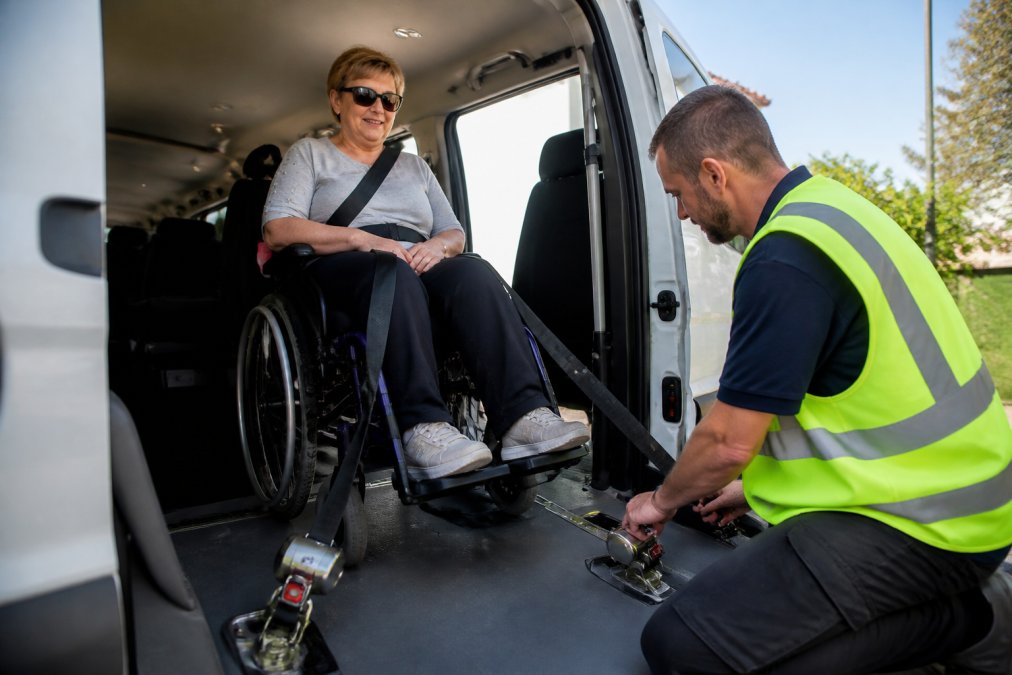
- Four-point tie-down straps that anchor the wheelchair frame, not just the wheels
- A separate lap and shoulder belt for the passenger, independent of the wheelchair restraints
- Clear floor space beside the secured wheelchair for a carer or companion
- Sliding door or wide side entry that opens fully without blocking the footpath
- Driver trained in wheelchair securement and passenger transfer assistance
- Vehicle licensed and inspected under the state’s taxi regulations
- Confirmation of the exact pick-up window in writing
The restraint system is the most overlooked item. A wheelchair held only by its wheels can shift under braking, so ask whether the operator uses a four-point tie-down.
Booking a standard maxi taxi and assuming it will carry a wheelchair is a common and costly mistake. Not every large vehicle has a ramp or certified tie-downs. If you do not confirm wheelchair access at the time of booking, you may be turned away at the kerb and miss an appointment.
Compare Wheelchair Taxi Services Perth: Key Differences
When you compare wheelchair taxi services in Perth, the differences that matter are not on the homepage. They show up at the kerb: whether the vehicle turns up, whether the driver is trained to secure your specific chair, and whether the quoted fare is the fare you pay. Operators fall into a few broad categories, each suiting a different trip.
Specialist local operators focus on one region with a direct phone line, suiting regular medical appointments nearby. Larger metropolitan providers run wider fleets with online booking, helping when you need a vehicle at short notice or across suburbs. Universal Cabs sits in the broader metropolitan group, with a mixed fleet including wheelchair accessible vehicles alongside sedans, SUVs and Maxi Taxis, bookable by phone or online.
| Service type | Booking method | Coverage | Best for |
|---|---|---|---|
| Metropolitan mixed fleet | Phone or online | Wide suburban coverage | Airport runs, varied daily trips |
| Specialist local operator | Direct phone line | Single region | Regular local appointments |
| Group and maxi focused | Phone or contact form | Metro-wide | Group travel with access needs |
The Questions That Actually Separate Operators
Most comparison tables stop at booking method and coverage. The useful comparison is narrower: ask each operator the same five questions and the differences become obvious:
- How many accessible vehicles are in your fleet, and how many are on the road at 7am on a weekday? A large total fleet means little if only a handful carry a ramp. The on-road figure at peak time determines whether you get a vehicle.
- What is the safe working load of your ramp or lift? This is the maximum weight the equipment is rated to carry, including the passenger. A powered chair plus occupant can exceed a lighter ramp’s rating, so confirm this before booking, not on arrival.
- Is the driver trained in four-point tie-down and passenger transfer? Securement training is not universal. A driver who has only loaded a folding manual chair may not know how to anchor a powered chair frame.
- Do you accept the Multi-Purpose Taxi Program membership, and how is it applied? Some operators process the subsidy at the meter; others require upfront payment and later claims. The difference affects your out-of-pocket cost.
- What is your cancellation and no-show policy for accessible bookings? Accessible vehicles are a smaller part of most fleets, so a late cancellation can leave you without a replacement. Know the policy before you book.
Booking Apps vs Phone Dispatch
The choice between an app and a phone call changes your experience more than most people expect. Apps give a fare estimate, a confirmed driver and live tracking, suiting routine trips you can plan ahead. Phone dispatch gives you a person who can ask about your wheelchair type, whether you travel with a carer, and how much space you need.
The trade-off cuts both ways. An app is faster to rebook and shows the vehicle approaching, but its form rarely has a field for wheelchair dimensions, ramp versus lift, or carer seating. A phone call takes longer and depends on operator hours, but lets you confirm the exact vehicle before committing. A common pattern: phone for the first booking with a new operator, then switch to the app for repeat trips once you know the fleet carries the right vehicle.
When you call, give the operator your wheelchair dimensions and whether it is powered or manual. A powered chair needs a higher safe working load and more floor space than a folding manual chair, and knowing this in advance prevents the wrong vehicle being sent.
What to Confirm in Writing
Whichever channel you use, get confirmation you can refer back to. A text or email stating the vehicle type, pick-up window and fare basis gives you a reference if the vehicle that arrives does not match your booking. If an operator will only confirm verbally, treat that as a signal about how the trip will be handled.
Multi-Purpose Taxi Program WA: How Subsidies Work
The Multi-Purpose Taxi Program (MPTP) is a Western Australian scheme helping eligible passengers with permanent disabilities reduce taxi travel costs (Passenger Transport Subsidy Scheme (PTSS)). It is administered by the state government, and eligibility is assessed against set criteria rather than granted automatically. The useful part is understanding how it works at the meter, where the subsidy either helps you or does not.
How the Subsidy Is Applied
The MPTP is a fare subsidy, not a cash payment or separately redeemed voucher. Once you hold a membership, you present your card when you travel and the subsidy is applied to the metered fare (Apply for PTSS). The operator charges you the reduced amount at the end of the trip and the scheme reimburses them for the subsidised portion, so you do not pay full fare and wait for a refund.
Because the subsidy is tied to the metered fare, it applies to taxi travel rather than a flat rate per trip. That matters for airport transfers and longer suburban runs, where the higher metered fare means a larger reduction. The benefit also scales with how much you travel, making the scheme most valuable to people relying on accessible transport several times a week.
Eligibility and How to Apply
Eligibility is based on permanent disability and assessed against set criteria, not granted on request. Applications go through the administering state agency and typically require supporting documentation from a medical practitioner confirming the nature and permanence of the disability. Membership is not automatic for wheelchair users; it is a separate assessment.
Because subsidy amounts, membership conditions and caps are set by the scheme and can change, we do not quote figures here. Check current details directly with the official program before budgeting for regular travel, and treat any third-party figure as indicative only.
What to Check Before You Book
Ask the operator whether they accept MPTP memberships before you book, since not every service processes them the same way. Some apply the subsidy at the meter; others are not set up to process memberships at all. If booking through an app, check whether the membership applies or whether you need to call. Getting this wrong means paying full fare and claiming nothing back.
The MPTP is not the same as the NDIS. The NDIS funds disability supports under a plan, while the MPTP is a fare subsidy for taxi travel. If you hold an NDIS plan, check whether transport is funded in your plan separately, because the two do not automatically combine.
Other Assistance Worth Knowing About
Beyond the MPTP, other avenues are often missed.
Wheelchair Accessible Taxi Booking: Step-by-Step
Reliable Airport Transfers for Wheelchair Users
Real-Time Availability and Wait-Time Transparency
For planned trips, always pre-book rather than hail. A confirmed accessible vehicle at a set time removes the biggest risk in accessible travel, which is a vehicle that never arrives.
Frequently Asked Questions
How do I book a wheelchair-accessible taxi?
You can book a wheelchair accessible taxi Perth by calling a local operator directly or using an online booking form. Provide your pickup address, destination, time, and whether you need a ramp or hydraulic lift. For airport trips, mention your flight number so the driver can track it. Pre-booking is recommended for medical appointments and early-morning flights, as on-demand availability varies across suburbs.
Are there government subsidies for wheelchair taxi travel?
Yes. The Multi-Purpose Taxi Program WA provides subsidised travel for eligible people with permanent disabilities. Eligibility is assessed by the Department of Transport, and the subsidy covers part of the fare on approved taxi services. You must apply and receive an MPTP card before travelling. Check the official Department of Transport website for current eligibility rules and how to apply.
What features should I look for in an accessible taxi service?
Look for vehicles with ramp access or a hydraulic lift, four-point tie-down restraint systems, and spacious interiors for mobility aids. Drivers should be trained in passenger safety and securement. Also check whether the service offers 24/7 availability, pre-booking, and door-to-door service. A specific accessibility feature checklist helps you compare operators objectively before you book.
Can I pre-book wheelchair-accessible transport for airport transfers?
Yes, pre-booking is strongly recommended for reliable airport transfers for wheelchair users. Reputable operators offer flight tracking, so the driver adjusts pickup time if your flight is delayed. Provide your flight number, terminal, and any mobility aid details at booking. Allow extra time for boarding and disembarking, especially during peak periods or public holidays.